
Hello everyone my name is Tejas, in this particular post I am going to post the MSBTE K scheme syllabus. In this particular post I am providing the syllabus of Civil Engineering, Computer Engineering, Electrical Engineering, Electronics and Communication & Mechnical Engineering.
In this post I am going to provide the syllabus of 1st year 1 semester only. In upcoming post, we are providing the 2nd semester to 6th semester.
Guys, for all lthe branches some subjects are same but some are different, like mathemematics, english, etc are the same subjects for every branch in 1st semester only.
Guys, I am the student of I scheme, and currently I am pursuing my B.Tech in Pimpri Chinchwad College of Engineering, Pune.
So, I know everything about the MSBTE (Maharashtra State Board of Technical Education). There are some minor change in the K scheme although I scheme and K scheme are same.
Beyond the topics I am speaking. so without wasting the time I am going to share the syllabus detailed of each course and each subjects.
Check out – MSBTE Diploma in Civil Engineering K Scheme Lab Manual from 1st Semester to 6th Semester
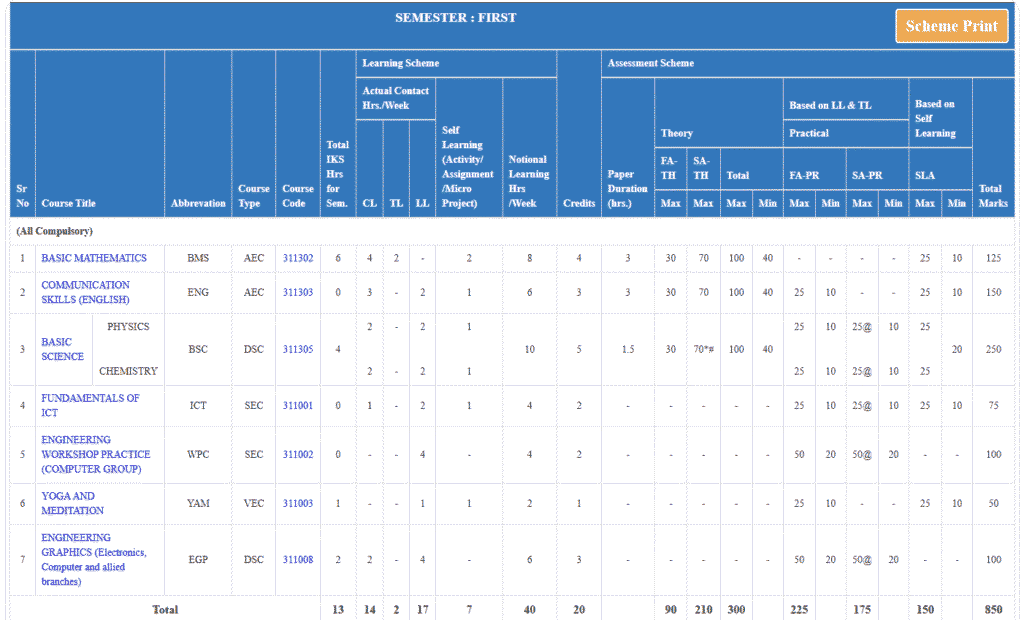
MSBTE K scheme Syllabus 1st semester Civil Engineering
There are total 7 subjects in 1st semester for Civil Engineering. The name of the subjects are as follows.
- Basic Mathematics
- Communication Skills
- Basic Science – Physics and Chemistry
- Fundamental of ICT
- Yoga and Meditation
- Engineering Graphics
- Civil Engineering Workshop
These all are the subjects of Civil Engineering in the 1st year. Friends, most of the students, are confused how to download the syllabus from the MSBTE official website. But don’t worry guys we are here to provide all the solution of the MSBTE.
MSBTE 311302 Basic Mathematics Syllabus
Friends, in this seciton I am going to listing the 311302 Basic Mathematics Units with sub topics. Guys, sub topics will help you to study properly.
| Unit – I Algebra | 1.1 Logarithm: Concept and laws of logarithm. 1.2 Matrices: Matrices, algebra of matrices, transpose, value of determinant of matrix of order 3×3, adjoint and inverse of matrices. 1.3 Matrices: Solution of simultaneous equations by matrix inversion method. 1.4 Partial Fractions: Types of partial fraction based on nature of factors and related Problems. 1.5 Algebra in Indian Knowledge System: Solution of simultaneous equations (Indian Mathematics).. |
| Unit – II Trigonometry | 2.1 Trigonometric ratios of allied angles, compound angles, multiple angles (2A, 3A), submultiples angles. (without proof) 2.2 Factorization and De factorization formulae. (without proof). 2.3 Inverse Trigonometric Ratios and related problems. 2.4 Principle values and relation between trigonometric and inverse trigonometric ratios. 2.5 Trigonometry in Indian Knowledge System: The Evolution of Sine Function in India. 2.6 Indian Trigonometry: Basic Indian Trigonometry- Introduction and Terminology (From Ancient Beginnings to Nilakantha). 2.7 Trigonometry in Indian Knowledge System: Pythagorean triples in Sulabasutras. |
| Unit – III Straight Line | 3.1 Straight line and slope of straight line: Angle between two lines, Condition of parallel and perpendicular lines. 3.2 Various forms of straight lines: Slope point form, two-point form, Double intercept form, General form. 3.3 Perpendicular distance from a point on the line. 3.4 Perpendicular distance between two parallel lines. 3.5 Geometry in Sulabasutras in Indian Knowledge System (construction of square, circling the square). (Indian Mathematics). |
| Unit – IV Differential Calculus | 4.1 Functions and Limits: Concept of function and simple examples. 4.2 Functions and Limits: Concept of limits without examples. 4.3 Derivatives: Rules of derivatives such as sum, Product, Quotient of functions. 4.4 Derivatives: Derivative of composite functions (chain Rule), implicit and parametric functions. 4.5 Derivatives: Derivatives of inverse, logarithmic and exponential functions. 4.6 Applications of derivative: Second order derivative without examples, Equation of tangent and normal, Maxima and minima, Radius of curvature. 4.7 Calculus in Indian Knowledge System: The Discovery of Calculus by Indian Astronomers.(Indian Mathematics). |
| Unit – V Statistics | 5.1 Range, coefficient of range of discrete and grouped data. 5.2 Mean deviation and standard deviation from mean of grouped and ungrouped data. 5.3 Variance and coefficient of variance. 5.4 Comparison of two sets of observation. |
MSBTE 311302 Basic Mathematics Weightage
| Unit Name | Weightage |
| Algebra | 14 |
| Trigonometry | 14 |
| Straight Line | 8 |
| Differential Calculus | 20 |
| Statistics | 14 |
MSBTE 311302 Basic Mathematics Laboratory Experiment / Practical Titles / Tutorial Titles
- Solve simple problems of Logarithms based on given applications.
- Solve elementary problems on Algebra of matrices for branch specific engineering related applications.
- Solve solution of Simultaneous Equation using inversion method.
- Apply Matrix Inversion method to determine currents through various branches of given electrical networks.
- Determine inverse of a non-singular matrix by using open source software.
- Resolve into partial fraction using linear non-repeated, repeated, and irreducible quadratic factors.
- Solve problems on Compound, Allied, multiple and sub multiple angles for related shapes.
- Practice problems on factorization and de factorization.
- Solve problems on inverse trigonometric ratios based on applications.
- Practice problems on equation of straight lines using different forms.
- Solve problems on perpendicular distance, distance between two parallel lines and angle between two lines.
- Use given form of straight line to calculate the speed, distance and time of moving object.
- Solve problems to find derivatives of implicit function and parametric function.
- Solve problems to find derivative of logarithmic and exponential functions for engineering applications.
- Solve problems based on finding equation of tangent and normal for engineering applications.
- Solve problems based on finding maxima, minima of function and radius of curvature at a given point for engineering applications.
- Use the concept of tangent and normal to solve the given problem of Engineering Drawing.
- Use the concept of Maxima and Minima to obtain optimum value for given engineering problem.
- Use the concept of radius of curvature to solve given branch specific engineering problem.
- Use the concept of derivative to find the slope of a bending curve for given engineering problem.
- Solve problems on finding range, coefficient of range and mean deviation for given applications.
- Solve problems on standard deviation, coefficient of variation and comparison of two sets.
- Calculate the Standard Deviation for Concrete with the given data for given engineering applications.
Note – Minimum 80% of above list of lab experiment are to be performed.
Judicial mix of LLOs are to be performed to achieve desired outcomes.
MSBTE 311303 Communication Skills Syllabus
Guys, In this section I am going to provide you 311303 Communication Skills Syllabus. Also I am going to provide you unit wise name and sub topics and weightage of each unit. It will help you at the time of the Final Semester exam.
| Unit Name | Sub topics |
| Unit – I Vocabulary | 1.1 Phonetics :Vowels(12) Consonants (24) Diphthongs (8) 1.2 Prefix & Suffix : . Definition & Examples , List of common prefixes and suffixes 1.3 Synonyms & Antonyms : Vocabulary expansion , Context & Usage 1.4 Homophones : Identifying Homophones , Meaning & Context , Vocabulary Expansion 1.5 Collocations : Definition & identification , Types of collocations |
| Unit – II Paragraph and Dialogue Writing | 2.1 Types of paragraphs: Technical , Descriptive , Narrative 2.2 Dialogue Writing: i Greetings ii. Development iii. Closing Sentence |
| Unit – III Comprehension (Seen and Unseen Passages) | 3.1 1 Passages from MSBTE workbook 1.Say No to Plastic bags 2.Interview of Dr. APJ Abdul Kalam 3.Maximum Achievements 4.Be Remarkable 5.Arunima Sinha: A Biography 6.Roses of Gratitude 3.2 Importance of Comprehension 3.3 Unseen Passages 3.4 Interpretation of passages in written and Spoken form |
| Unit – IV Communicative Language | 4.1 Technical objects : i. Heading ii. Description of technical objects 4.2 Picture Description : i. Situational picture ii. Describe in your own words 4.3 Diary Entry : i. Date ii. Content iii. Name of the writer 4.4 Translation of paragraph from English to Marathi/Hindi-Vice versa (Question not to be asked on Translation in Theory Examination) |
| Unit – V Presentation Skills | 5.1 Dressing & Grooming : i. Dressing for the occasion ii. Proper grooming 5.2 Speech Writing : i. Situation ii. Salutations iii. Introduction of the topic iv. Description/Body v. Conclusion 5.3 Power Point Presentation : i. Layout ii. Font size iii. Color combination 5.4 Kinesics : i. Facial expressions ii Eye contact iii Postures iv Gestures |
311303 Communication Skills Weightage
| Unit Name | Total Marks |
| Vocabulary | 12 |
| Paragraph and Dialogue Writing | 12 |
| Comprehension (Seen and Unseen Passages) | 24 |
| Communicative Language | 14 |
| Presentation Skills | 8 |
MSBTE 311303 Communication Skills Laboratory Experiements
- *Write 20 words using phonetic transcription
- Practice pronunciation as per IPA using language lab
- *Formulate 20 words using Prefix and Suffix
- *Construct sentences using 20 collocations
- *Write two paragraphs of 75 words each
- *Compose situational dialogues (Any Two)
- Enact Role Plays as per situation and context
- *Describe any three technical objects using correct grammar
- Narrate anecdotes of various situations in English
- *Describe a given picture (Any Two)
- *Introduce oneself and others
- *Prepare a Power point presentation on a given topic
- *Translate paragraph –English to Marathi/Hindi (vice -Versa) (Any4)
- *Write your experience in 50 words on ( Four) given situations (Diary Entry)
- *Respond to the questions based on the given passages
- Deliver oral presentations using correct grammar and appropriate body language
MSBTE 311305 Basic Science – Physics and Chemistry
Friends, in this section I am going to share the Basic Science – Physics and Chemistry syllabus including unit, subtopics, weightage and laboratory experiments.
| Unit Name | Subtopics |
| Unit – I Units and Measurements | 1.1 Unit, physical quantities: fundamental and derived quantities and their units Systems of units: CGS, MKS and SI . 1.2 Scalar and Vector Physical Quantities. 1.3 Dimensions, dimensional formula ,Applications of dimensional analysis; correctness of physical equations ,conversion factor for interconversion of units in different systems of units. 1.4 Errors, types of errors: instrumental, systematic and random error, estimation of errors: absolute, relative and percentage error, significant figures. 1.5 Ancient astronomical instruments:Chakra, Dhanuryatra , Yasti and Phalaka yantra . 1.6 Applications of Vernier calipers , Screw gauge. |
| Unit – II Electricity, Magnetism and Semiconductors | 2.1 Concept of charge, Coulomb’s inverse square law, Electric field, Electric field intensity, potential and potential difference. 2.2 Magnetic field and magnetic field intensity and its units, magnetic lines of force, magnetic flux . 2.3 Electric current, Ohm’s law, specific resistance, laws of series and parallel combination of resistance, conversion of galvanometer into ammeter and voltmeter, Heating effect of electric current . 2.4 Conductors, Insulators and Semiconductors, Energy bands, intrinsic and extrinsic semiconductors, minority and majority charge carriers. 2.5 p-n junction diode, Depletion layer I-V characteristics of p-n junction, static and dynamic resistance, applications of p-n junction diode ,: Half wave rectifier. |
| Unit – III Thermometry and Fiber Optics | 3.1 Heat, temperature, temperature scale: Degree Celsius, degree Kelvin, degree Fahrenheit. 3.2 Modes of heat transfer: Conduction , Convection and Radiation , Applications in daily life . 3.3 Boyle’s law, Charle’s law, Gay Lussac’s law, perfect gas statements equations and simple numerical. 3.4 Law of thermal conductivity ,Newton’s law of cooling. 3.5 Law of refraction, total internal reflection. 3.6 Optical fibber: Principle, construction and working Types of Optical fibers;Single mode step index, Multimode step index, Multimode graded index Applications of optical fibers. |
| Unit – IV Chemical bonding | 4.1 Indian Chemistry:-Philosophy of atom by Acharya Kanad. 4.2 Electronic theory of valency: Assumptions , Chemical bonds: Types and characteristics of electrovalent bond, covalent bond, coordinate bond, hydrogen bond, metallic bond and Intermolecular forces of attraction. 4.3 Molecular arrangement in solid, liquid and gases. 4.4 Structure of solids: crystalline and amorphous solids ,Properties of metallic solid, Unit cell: simple cubic, body center cubic (BCC) , face centre cubic (FCC), hexagonal close pack crystals. |
| Unit – V Electro chemistry and Metal Corrosion, its prevent ion | 5.1 Electrolyte- Types of electrolyte, ionization and dissociation ,Cathode, Anode, Electrode potential: oxidation and reduction, Mechanism of electrolysis :Electrolysis, Electrochemical series for cations and anions. Mechanism of electrolysis of CuSO4 solution 5.2 Faraday’s laws of electrolysis: Faraday’s first and second law, relation between electrochemical equivalent and chemical equivalent, Numerical. Applications of electrolysis: Electro-refining of copper and Electroplating. 5.3 Difference between primary and secondary cell. 5.4 Corrosion: Definition and Types of corrosion Dry corrosion: Mechanism, Types of oxide film, Wet corrosion :Mechanism hydrogen evolution in acidic medium, oxygen absorption in neutral or alkaline medium ,Galvanic cell action by Daniel cell. 5.5 Factors affecting the rate of corrosion. 5.6 Corrosion control: Modification of environment, Use of protective coatings, coating of less active metal like Tin (Tinning), coating of more active metal like Zinc (Galvanizing), Anodic and cathodic protection, Choice of material-using pure metal and using metal alloy. |
| Unit – VI Engineering Materials and Catalysis | 6.1 Paints: Purposes of applying paint, Characteristics of paints, Ingredients of paints, Function and examples of each ingredient. 6.2 Varnish: Types, Difference between paint and varnishes. 6.3 Insulators: Characteristics, Classification,Properties and Application of Glass wool Thermocol. 6.4 Polymer and Monomer : Classification on the basis of Molecular structure, on the basis of monomers (homo polymer and copolymer), on the basis of Thermal behavior(Thermoplastics and Thermosetting). 6.5 Types Polymerization Reaction, Addition Polymerization, Condensation Polymerization, Synthesis, properties and application of Polyethylene, Polyvinyl chloride, Teflon, Polystyrene, Phenol formaldehyde, Epoxy Resin. 6.6 Adhesives: Characteristics, Classification and their uses 6.7 Lubricants: Classification, properties and Applications. 6.8 Catalysis: Types of catalysis homocatalysis ,heterocatalysis . 6.9 Catalyst: Types of Catalyst Positive, Negative and Auto-catalyst, Catalytic Promoter and Catalytic inhibitor, Industrial application of catalyst. |
MSBTE 311305 Basic Science Weightage
| Unit Name | Total Marks |
| Units and Measurements | 9 |
| Electricity, Magnetism and Semiconductors | 14 |
| Thermometry and Fiber Optics | 12 |
| Chemical bonding | 9 |
| Electro chemistry and Metal Corrosion, its prevent ion | 12 |
| Engineering Materials and Catalysis | 14 |
MSBTE 311305 Basic Science Laboratory Experiment
- Measurements of dimensions of given object by Vernier caliper
- Measurements of dimensions of given objects by micrometer screw gauge.
- Determination of resistance by Ohm’s law.
- Determination of specific resistance of given wire.
- Determination of equivalent resistance in series connection of resistors.
- Determination of equivalent resistance in parallel connection of resistors.
- Determination of neutral points by magnetic compass.
- Determination of static and dynamic resistance of given P N junction diode.
- Determination of forbidden energy band gap in semiconductors.
- Determination of Joule’s mechanical equivalent of heat by Joule’s law.
- Determination of pressure-volume relation using Boyle’s law.
- Determination of the rate of heat loss due to convection by Newton’s law of cooling
- Determination of Coefficient of thermal conductivity.
- Determination of the refractive index of glass slab.
- Determination of the Numerical Aperture (NA) of a given step index optical fiber.
- Identification of cation in given ionic solutions.
- Identification of anion in given ionic solutions.
- Identification of states of matter.
- Determination of electrode potential of copper.
- Determination of electrode potential of Iron metal.
- Determination of the voltage generated from chemical reaction using Daniel Cell.
- Determination of electrochemical equivalent of Cu metal using Faraday’s first law.
- Determination of equivalent weight of metal using Faraday’s second law.
- Preparation of corrosive medium for Aluminium at different temperature.
- Determination of rate of corrosion at different temperatures for Aluminium.
- Determination of effect of temperature on viscosity for given lubricating oil using Redwood viscometer-I.
- Determination of the steam emulsification number of given lubricating oil.
- Determination of flash and fire point of given lubricating oils using Cleveland open cup apparatus.
- Determination of flash point of given lubricating oil using Abel’s closed cup apparatus.
- Determination of thinner content in oil paint.
Note – Minimum 80% of above list of lab experiment are to be performed.
Judicial mix of LLOs are to be performed to achieve desired outcomes.
MSBTE 311001 Fundamentals of ICT
| Unit Name | Subtopics in a Units |
| Unit – I Introduction to Computer System | 1.1 Basics of Computer System: Overview of Hardware and Software: block diagram of Computer System, Input/Output unit CPU, Control Unit, Arithmetic logic Unit (ALU), Memory Unit 1.2 Internal components: processor, motherboards, random access memory (RAM), read-only memory (ROM), video cards, sound cards and internal hard disk drives) 1.3 External Devices: Types of input/output devices, types of monitors, keyboards, mouse, printers: Dot matrix, Inkjet and LaserJet, plotter and scanner, external storage devices CD/DVD, Hard disk and pen drive 1.4 Application Software: word processing, spreadsheet, database management systems, control software, measuring software, photo-editing software, video-editing software, graphics manipulation software System Software compilers, linkers, device drivers, oper 1.5 Network environments: network interface cards, hubs, switches, routers and modems, concept of LAN, MAN, WAN, WLAN, Wi-Fi and Bluetooth 1.6 Working with Operating Systems: Create and manage file and folders, Copy a file, renaming and deleting of files and folders, Searching files and folders, application installation, creating shortcut of application on the desktop. |
| Unit – II Word Processing | 2.1 Word Processing: Overview of Word processor Basics of Font type, size, colour, Effects like Bold, italic, underline, Subscript and superscript, Case changing options, Previewing a document, Saving a document, Closing a document and exiting application. 2.2 Editing a Document: Navigate through a document, Scroll through text, Insert and delete text, Select text, Undo and redo commands, Use drag and drop to move text, Copy, cut and paste, Use the clipboard, Clear formatting, Format and align text, Formatting 2.3 Changing the Layout of a Document: Adjust page margins, Change page orientation, Create headers and footers, Set and change indentations, Insert and clear tabs 2.4 Inserting Elements to Word Documents: Insert and delete a page break, Insert page numbers, Insert the date and time, Insert special characters (symbols), Insert a picture from a file, Resize and reposition a picture 2.5 Working with Tables: Insert a table, Convert a table to text, Navigate and select text in a table, Resize table cells, Align text in a table, Format a table, Insert and delete columns and rows, Borders and shading, Repeat table headings on subsequent page 2.6 Working with Columned Layouts and Section Breaks: a Columns, Section breaks, Creating columns, Newsletter style columns, Changing part of a document layout or formatting, Remove section break, Add columns to remainder of a document, Column widths, Adjust |
| Unit – III Spreadsheets | 3.1 Working with Spreadsheets: Overview of workbook and worksheet, Create Worksheet Entering sample data, Save, Copy Worksheet, Delete Worksheet, Close and open Workbook. 3.2 Editing Worksheet: Insert and select data, adjust row height and column width, delete, move data, insert rows and columns, Copy and Paste, Find and Replace, Spell Check, Zoom In-Out, Special Symbols, Insert Comments, Add Text Box, Undo Changes, – Freeze 3.3 Formatting Cells and sheet: Setting Cell Type, Setting Fonts, Text options, Rotate Cells, Setting Colors, Text Alignments, Merge and Wrap, apply Borders and Shades, Sheet Options, Adjust Margins, Page Orientation, Header and Footer, Insert Page Breaks, S 3.4 Working with Formula: Creating Formulas, Copying Formulas, Common spreadsheet Functions such as sum, average, min, max, date, In, And, or, mathematical functions such as sqrt, power, applying conditions using IF. 3.5 Working with Charts: Introduction to charts, overview of different types of charts, Bar, Pie, Line charts, creating and editing charts. Using chart options: chart title, axis title, legend, data labels, Axes, grid lines, moving chart in a separate sheet. 3.6 Advanced Operations: Conditional Formatting, Data Filtering, Data Sorting, Using Ranges, Data Validation, Adding Graphics, Printing Worksheets, print area, margins, header, footer and other page setup options. |
| Unit – IV Presentation Tool | 4.1 Creating a Presentation: Outline of an effective presentation, Identify the elements of the User Interface, Starting a New Presentation Files, Creating a Basic Presentation, Working with textboxes, Apply Character Formats, Format Paragraphs, View a Prese 4.2 Inserting Media elements: Adding and Modifying Graphical Objects to a Presentation – Insert Images into a Presentation, insert audio clips, video/animation, Add Shapes, Add Visual Styles to Text in a Presentation, Edit Graphical Objects on a Slide, Format 4.3 Working with Tables: Insert a Table in a Slide, Format Tables, and Import Tables from Other Office Applications. 4.4 Working with Charts: Insert Charts in a Slide, Modify a Chart, Import Charts from Other Office Applications. |
| Unit – V Basics of Internet and Emerging Technologies | 5.1 World Wide Web: Introduction, Internet, Intranet, Cloud, Web Sites, web pages, URL, web servers, basic settings of web browsers- history, extension, default page, default search engine, creating and retrieving bookmarks, use search engines effectively for 5.2 Web Services: e-Mail, Chat, Video Conferencing, e-learning, e-shopping, e-Reservation, e-Groups, Social Networking 5.3 Emerging Technologies: IOT, AI and ML, Drone Technologies,3D Printing. 5.4 Tools: Docs, Drive, forms, quiz, Translate and other Apps |
MSBTE 311001 Fundamentals of ICT Laboratory Experiment
- * a) Work with Computer System, Input/output devices, and peripherals. b) Work with files and folders
- *Work with document files: a) Create, edit and save document in Word Processing. b) Text, lines and paragraph level formatting
- Work with Images and Shapes in Word Processing.
- *Work with tables in Word Processing.
- *Working with layout and printing a) Document page layout, Themes, and printing. b) Use of mail merge with options.
- *Create, open and edit Worksheet.
- *Formulas and functions in Worksheet.
- *Sort, Filter and validate data in Spreadsheet.
- *Charts for Visual Presentation in Spreadsheet.
- Worksheet Printing.
- *Make Slide Show Presentation.
- *Use Tables and Charts in Slide
- *a) Insert Animation effects to Text and Slides. b) Insert Audio and Video files in presentation
- a) Internet connection configuration b) Use Internet and Web Services.
- Working with Browsers.
- *Prepare Web Forms for Survey.
- *Prepare Web Forms for Quiz
Note – When marked with “*” such practicals are mandatory from exam point of view
| Unit Name | Marks |
| Introduction to Computer System | 0 |
| Word Processing | 0 |
| Spreadsheets | 0 |
| Presentation Tool | 0 |
| Basics of Internet and Emerging Technologies | 0 |
MSBTE 311003 YOGA AND MEDITATION Syllabus
| Sr.No. | Laboratory Experiments |
| LLO 1.1 Practice warming up for Yoga. | ntroduction :- Presentations on Introduction to Yoga and its History. Lab Exp: 1. Perform warming up exercises to prepare the body from head to toe for Yoga. |
| LLO 2.1 Practice Surya Namaskar | Lab Exp: 2. Perform all the postures of Surya Namaskar one by one in a very slow pace, after warm up. Lab Exp 3. Perform multiple Surya Namaskar ( Starting with three and gradually increasing it to twelve) in one go. Experiment 2 to 4 must be followed by shavasana for self relaxation. |
| LLO 3.1 Practice basic Asanas | Lab Exp: 4 Perform Sarvangasna,Halasana,Kandharasana (setubandhasana) Lab Exp: 5 Perform Bhujangasana,Naukasana,Mandukasana Lab Exp: 6 Perform Paschimottasana,Baddhakonasana,Bharadwajasana. Lab Exp: 7 Perform Veera Bhadrasana,Vrukshasana,Trikonasana. Follow up experiment 5 to 7 with shavasana for self relaxation |
| LLO 4.1 Practice basic pranayama | Lab Exp: 8 Perform Bhastrika, Anulom Vilom Pranayam Kriya Lab Exp: 9 Practice Kapalbhati Pranayam Kriya Lab Exp:10 Practice Bhramary Pranayam. |
| LLO 5.1 Practice meditation | Lab Exp: 11 Perform sitting in Dhyan Mudra and meditating.Start with five minute and slowly increasing to higher durations. (Trainer will explain the benefits of Meditation before practice) |
Note – There are no weightage mentioned for 311003 Yoga and Meditation.
MSBTE 311006 ENGINEERING GRAPHICS (Civil, Electrical, Mechanical and allied branches)
| Unit Name | Subtopics |
| Unit – I Basic Elements of Drawing | 1.1 Drawing Instruments and supporting material: method to use them with applications. 1.2 Standard sizes of drawing sheets (ISO-A series) 1.3 I.S. codes for planning and layout. 1.4 Letters and numbers (single stroke vertical) 1.5 Convention of lines and their applications. 1.6 Scale – reduced, enlarged & full size 1.7 Dimensioning techniques as per SP-46 (Latest edition) – types and applications of chain, parallel and coordinate dimensioning 1.8 Geometrical constructions. |
| Unit – II Engineering curves & Loci of Points. | 2.1 Concept and understanding of focus, directrix, vertex and eccentricity. Conic sections. 2.2 Methods to draw an ellipse by Arcs of circle method & Concentric circles method. 2.3 Methods to draw a parabola by Directrix-Focus method & Rectangle method 2.4 Methods to draw a hyperbola by Directrix-Focus method. 2.5 Methods to draw involutes: circle & pentagon 2.6 Methods to draw Cycloidal curve: cycloid, epicycloid and hypocycloid 2.7 Methods to draw Helix & Archimedean spiral. 2.8 Loci of points on Single slider crank mechanism with given specifications. |
| Unit – III Orthographic Projections | 3.1 Introduction of projections-orthographic, perspective, isometric and oblique: concept and applications.(No question to be asked in examination) 3.2 Introduction to orthographic projection, First angle and Third angle method, their symbols. Conversion of pictorial view into Orthographic Views – object containing plain surfaces, slanting surfaces, slots, ribs, cylindrical surfaces. (use First Angle Pr |
| Unit – IV Isometric Projections | 4.1 Introduction to Isometric projection. 4.2 Isometric scale and Natural Scale. 4.3 Isometric view and isometric projection. 4.4 Ilustrative problems related to simple objects having plain, slanting, cylindrical surfaces and slots on slanting surfaces. 4.5 Conversion of orthographic views into isometric View/projection. (For branches other than mechanical Engineering, the teacher should select branch specific elements) |
| Unit – V Free Hand Sketches of Engineering Elements | 5.1 5.1 Free hand sketches of machine elements: Thread profiles, nuts, bolts, studs, set screws, washers, Locking arrangements. (For branches other than mechanical Engineering, the teacher should select branch specific elements for free hand sketching) |
311006 Engineering Graphics for Civil Engineering
- * Draw horizontal, vertical, 30 degree, 45 degree, 60 & 75 degrees lines using Tee and Set squares/ drafter. (Sketch Book).
- * Draw different types of lines, dimensioning styles (Sketch Book)
- * Draw one figure showing dimensioning techniques, two problems on redraw the figures and one problem on loci of points – slider crank mechanism. (Sketch Book)
- * Draw one figure showing dimensioning techniques, two problems on redraw the figures and one problem on loci of points – slider crank mechanism. (01 Sheet)
- * Draw any four Engineering Curves (Sketchbook)
- * Draw any four Engineering Curves – (01 Sheet)
- * Draw two problems on orthographic projections using first angle method of projection having plain surfaces, slanting surfaces and slots etc.- ( Sketchbook)
- Draw two problems on orthographic projections using first angle method of projection having plain surfaces, slanting surfaces and slots etc.- (01 Sheet)
- Draw two problems on orthographic projections using first angle method of projection having cylindrical surfaces, ribs etc. (Sketchbook)
- * Draw two problems on orthographic projections using first angle method of projection having cylindrical surfaces, ribs etc.- (01 Sheet)
- * Draw two problems on Isometric view of simple objects having plain and slanting surfaces by using natural scale. (Sketchbook)
- Draw two problems on Isometric view of simple objects having plain and slanting surfaces by using natural scale. ( 01 sheet)
- Draw two problems on Isometric Projection of objects having cylindrical surfaces and slots on slanting surfaces by using isometric scale.(Sketchbook)
- * Draw two problems on Isometric Projection of objects having cylindrical surfaces and slots on slanting surfaces by using isometric scale. ( 01 sheet)
- Problem Based Learning: Given the orthographic views of at least three objects with few missing lines, the student will try to imagine the corresponding objects, complete the views and draw these views (sketch book).
- * Draw freehand Sketches of 12 different standard components (Sketch book)
- Draw freehand Sketches of 12 different standard components (1 Sheet)
- * Correlate ancient Indian sculptures, Indian temples, Monuments, etc. with Engineering Graphics
Note – All the practicals marked with the “*” symbols is mandatory. It is expected to complete all the practicals.
MSBTE 311006 Engineering Graphics
| Unit Name | Unitwise Weightage |
| Basic Elements of Drawing | 6 |
| Engineering curves & Loci of Points. | 6 |
| Orthographic Projections | 14 |
| Isometric Projections | 14 |
| Free Hand Sketches of Engineering Elements | 10 |
MSBTE 311010 Civil Engineering Workshop
| Unit Name | Subtopics |
| Unit – I Safety Practices & Precautions | 1.1 1.1 Safety Practices, Causes of accidents, General safety rules, Safety signs and symbols, Safety Precaution. 1.2 1.2 First Aid box and its constituent materials. 1.3 1.3 Fire, Causes of Fire, Basic ways of extinguishing the fire Classification of fire, Firefighting equipment, fire extinguishers (Class A, B, C, D).( As per NBC 2016). 1.4 1.4 Workshop Layout: Issue and return system of tools, equipment and consumables. |
| Unit – II Construction Activities | 2.1 Construction activities such as layout, excavation, brick masonry, concreting, plumbing, electrification, Interdependency of various activities. 2.2 Causes of accidents, Safety Practices and Precaution. |
| Unit – III Masonary & Finishing works | 3.1 Brick and stone Masonry work, Types of bonds and joints (vertical and horizontal) 3.2 String (Line dori), plumb bob, right angle and water level tube. 3.3 Plastering (Internal & External) work. 3.4 Pointing work 3.5 Types of Formwork with safety measures. 3.6 False ceiling, Plaster of Paris (POP) work. 3.7 Aluminum glass works, cladding. 3.8 Different types of flooring and its application 3.9 Dado with its importance 3.10 Whitewash and painting: -Tools required, brush, roller and spray-painting preparation of surface for timber and steel members for painting. |
| Unit – IV Plumbing Fixtures | 4.1 Different types of pipes, Joints, Taps. Fixtures and accessories used in plumbing. 4.2 Components (pipes, valves bends.) used in water supply/sanitary/ sewerage lines. 4.3 Pipe fittings- bends, elbows, tees, cross, coupler, socket, reducer, cap, plug, nipple and their Specifications 4.4 Various Operation in plumbing shops- pipe bending machine their specifications and maintenance. Basic process cutting, threading etc. |
| Unit – V Sheet Metal | 5.1 Sheet metal hand tools snip, shears sheet gauge, straight edge, L square, scriber, divider, trammel, punches, pliers, stakes, groovers, limit set and their Specifications 5.2 Operation of machineries in sheet metal shops- sheet cutting and bending machine their specifications and maintenance. 5.3 Basic process- marking, bending, folding, edging, seaming, staking, riveting. |
| Unit – VI Carpentry Work | 6.1 Types of engineered woods such as plywood, block board, hardboard, laminated boards, Veneer, fiber Boards and their applications. 6.2 Wood working hand tools carpentry vice, marking and measuring tools, saws, claw hammer, mallet, chisels, plans, squares, and their specifications 6.3 Operation of wood working machineries – Wood turning lathe, circular saw, their specifications and maintenance. 6.4 Basic process- marking, sawing, planning, chiseling, turning, grooving, boring. 6.5 Components of wood work- different types of Hinges, tower bolts, brackets etc. |
311010 Civil Engineering Workshop Laboratory Experiments
- * Operate the fire extinguisher available in laboratory (Any two types)
- Perform mock drill for extinguishing fire. (Group of 10 students preferably)
- * Prepare the report of site visit of a construction project with reference to substructure construction activities along with the equipment used.
- * Perform the lineout activity on the site for the given type of foundation work.
- * Prepare a report on the observation carried on the site regarding the safety precautions followed during construction activities.
- Prepare a report on different equipment involved in agricultural activities
- Prepare a report on vernacular construction techniques used in old constructions.
- * Prepare the schematic diagram of the given structure by measuring its dimensions using measuring tape
- Conduct the survey of the construction material through internet with reference to their properties, cost and utilities.
- * Prepare the report of site visit of a construction project with reference to superstructure construction activities along with the equipment used.
- * Construct a corner brick wall using the relevant type of bond by ensuring wall is in straight line, plumb and at right angle. (Group of 10 students).
- * Transfer the marked level at the required location by using water tube level for a given construction activity.
- * Conduct the various field test on the given sample of cement to check its quality.
- * Conduct the various field test on the given sample of brick to check its quality.
- * Prepare the pipe line of required length using the given type of fittings.
- * Connect the two pipes of given diameters in the form of T- joint by using relevant pipe fitting.
- * Prepare the given shape of sheet metal utility job (tray, dustbin, letter box, fire bucket etc.) using following operations – Cutting And Bending, Edging, End Curling, Lancing, Welding, Riveting
- Perform the sawing operation on the given sample of wood to convert rough surface to smooth and levelled surface.
- Draw the labelled diagram of truss reflecting the tongue and groove joints with brief note on it.
- * Compile the information in a report format, regarding latest construction equipment used in a construction project through internet surfing.
- Prepare the architectural model of the given structure using relevant types of materials.
- Prepare the model of farm pond of the given capacity by using relevant materials.
- Prepare a report on various ancient tools/modern tools.(Any Five each)
- * Prepare a report on the site visit of a Heritage structures/ Ancient structure available in the immediate vicinity (Any Two)